

Frequently Asked Questions
The CAF giving portal accepts a range of secure payment methods, and can process Gift Aid on your donations if appropriate. You can make one-off donations using a credit or debit card or PayPal, and you can set up regular donations by Direct Debit. You can also donate via BACS transfer, or from your own CAF account. The CAF portal is accessed from our website donation page.
If you prefer to give direct to our bank, the account details are:
Account name: The Fred Hollows Foundation UK
Account number: 41313673
Sort Code: 40-11-60
If you make your donation through the CAF portal, you will receive a receipt directly from CAF. If you choose to give direct, please contact The Fred Hollows Foundation and the team will be very happy to arrange a receipt for you and if necessary to provide you with the Gift Aid declaration form.
Yes, potentially. If you are a UK taxpayer, you can make your donation go further by adding Gift Aid through the CAF giving platform. This allows The Fred Hollows Foundation to claim an extra 25p for every £1 you donate, at no additional cost to you. The option to add Gift Aid will appear during the donation process, or you can request a Gift Aid declaration form from us. If you have any questions, the team at The Fred Hollows Foundation will be happy to help.
You can get in touch with someone on our London Fundraising Team via [email protected].
Your donation will be used to restore sight to those who are needlessly blind, and help end avoidable blindness in the countries where we work, which includes eye operations and treatments, training surgeons and eye health workers, and other sustainable eye health.
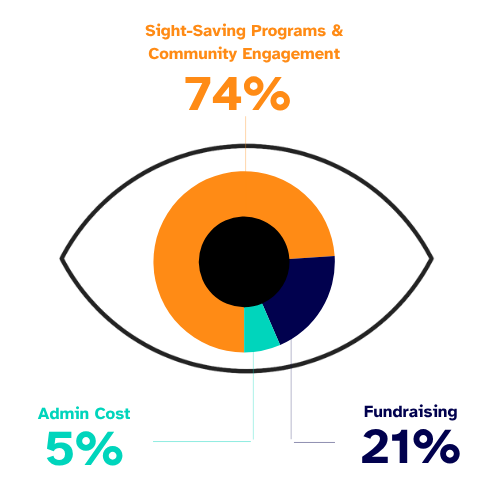
The Foundation is a global organisation with headquarters in Australia, and the following statistics reflect our operations worldwide. For every £1 donated, 74.1% goes directly towards eye health programs, 5.2% is necessary for admin costs, and 20.7% goes towards investment in fundraising efforts, which allows us to help even more people in future years.
While the cost of cataract surgery varies depending on the specific operating environments in the countries where we work, in some countries it is possible to restore sight for as little as $25.
Our $25 cost includes the three key things needed to restore sight – the surgeon’s time, the consumable equipment and the intraocular lens (IOL) which replaces the cataract.
The most important element in modern cataract surgery is the IOL – Fred Hollows used to refer to them as "the most expensive pieces of plastic in the world". Reducing the cost of the IOL was the fundamental factor in making cataract surgery affordable.
Today, IOL prices vary significantly – including in low and middle-income countries.
In October 2021 The Foundation evaluated our program costs for small incision cataract surgery in countries including Pakistan, Bangladesh and Cambodia to ensure the $25 cost remained accurate.
Our assessment showed IOLs start from $4 in Pakistan, about $6 in Cambodia, and about $14 in Bangladesh.
The other key costs are the surgeon’s time (which is less than $1.50 per patient in those three countries) and consumable equipment (as little as $5.46).
So with the cost of the IOL, the surgeon and the consumables it is possible that The Foundation can restore sight for as little as $25 in some countries.
We acknowledge that not all surgeries in all countries are as little as $25. The cost of surgery depends on factors including the country of treatment, the age and circumstances of the patient, how and where the treatment is delivered, the type of procedure, the IOL used, the hospital type (government or private), the facilities of the hospital, inpatient or day procedure delivery mechanisms, and the economic status of people in the country or region.
