

Our vision for reconciliation
A future in which Aboriginal and Torres Strait Islander peoples, always exercise their inalienable rights to good health, sight and self-determination. This is supported by an organisation whose relationships, culture and governance reflect deep respect, accountability and allyship.
What the RAP prioritises
Align our work with First Nations rights
Aligning business practice and advocacy with the Uluru Statement from the Heart.
Strengthen meaningful allyship
Strengthening structures for impactful and accountable allyship.
Build cultural capability and safety
Building the cultural capability, safety and responsiveness of the organisation.
Our commitments to reconciliation

Relationships
We are moving from transactional to relational engagement and deepening our relationships with Aboriginal and Torres Strait Islander peoples and organisations.
This includes strengthening partnerships with Aboriginal Community Controlled Health Organisations, the First Nations Eye Health Alliance and the Allies for Uluru coalition, and continuing to recognise and celebrate National Reconciliation Week.

Respect
Cultural learning for 100% of Australian staff; cultural immersion for leaders and the RAP Implementation Working Group (RIWG); strengthening anti-discrimination policies and public leadership against racism.

Opportunities
We are working to grow Aboriginal and Torres Strait Islander employment, retention and career pathways within our organisation.
We are also expanding First Nations procurement, creating more opportunities to work with Aboriginal and Torres Strait Islander businesses.

Governance
Reconciliation requires leadership and accountability.
Our CEO is the RAP Executive Sponsor, supported by an active RAP Implementation Working Group led by the Senior RAP Implementation Advisor.
The RAP will be a standing item at quarterly leadership meetings, with annual public reporting and a final traffic-light report to Reconciliation Australia in March 2028.
A continuing journey, grounded in Fred's legacy
Reconciliation is part of The Fred Hollows Foundation's history and continues to shape our work today.
In 1968, Fred Hollows visited a rural camp on Gurindji Country in the Northern Territory. He saw the devastating impact of trachoma and the wider health inequalities experienced by Aboriginal and Torres Strait Islander peoples.
Fred was driven by a belief in equality and a determination to challenge the injustices he saw. His commitment to Aboriginal and Torres Strait Islander peoples, and to the right to good health and sight, remains a cornerstone of The Foundation's work today.
Who we are today
The Foundation employs 418 people across 25 countries, 192 of them in Australia — 7.2% of Australian staff identify as Aboriginal and/or Torres Strait Islander. We are co-convenors of Allies for Uluru, convenors of the IAPB Indigenous Peoples Special Interest Group, and long-standing sponsors of the Close the Gap campaign.
The story on the cover
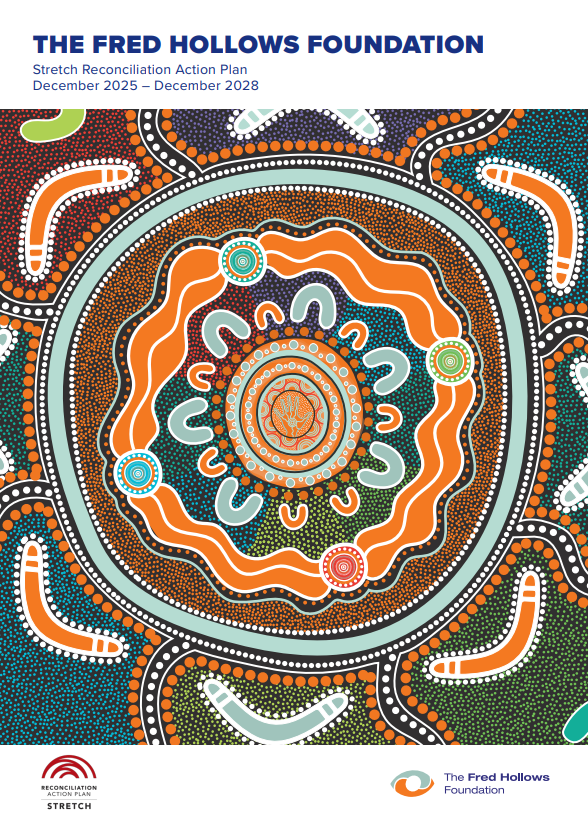
The cover artwork was created by Rheanna Lotter (Ngandabaa), a Yuin woman from Wollongong. At its centre sits The Foundation, ringed by our four values and boomerangs of resilience and strength. Connection lines travel outward, sight restored, confidence built, communities strengthened, until the painting itself steps off the canvas and keeps giving.

Reconciliation is an ongoing commitment
Reconciliation is not a one-off moment or something that can be achieved through a single plan.
It is an ongoing commitment to listening, learning and action.
Our Stretch RAP 2025–2028 gives us a framework to turn that commitment into practical change. It belongs to all of us to own, contribute to and lead.
Download The Fred Hollows Foundation Stretch Reconciliation Action Plan 2025–2028.
Please contact Gerry Finnigan Senior RAP Implementation Advisor [email protected] if you have any questions.
