
From commitment to action: launching our new Reconciliation Action Plan (2025–2028)

Reconciliation is an ongoing journey. It is a practice that must be renewed and strengthened over time.
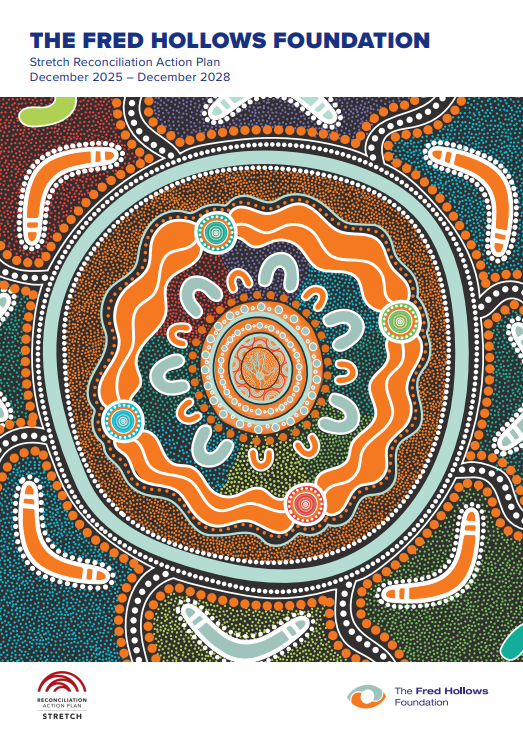
The launch of The Fred Hollows Foundation’s new Stretch Reconciliation Action Plan (RAP) 2025–2028, takes us another step forward in that practice. This RAP builds on more than a decade of learning, and on a simple proposition: reconciliation only happens when there is visible and demonstrable positive cultural change in how we work every day.
Grounded in purpose, shaped by accountability
The Foundation was established to continue Fred Hollows’ work advancing eye health and health equity, including his early advocacy alongside Aboriginal and Torres Strait Islander peoples. That legacy continues to shape our purpose today.
Our RAP is not separate from our core work – it is a cornerstone of our work and embodies a central belief of Fred, that all human life is sacred, deserves dignity and respect.
Across Australia, we work with Aboriginal and Torres Strait Islander communities and Community Controlled Health Organisations to improve access to culturally safe, high-quality eye care. Our RAP aims to strengthen how we do that work, and how we hold ourselves accountable while doing it.
It is guided by the Uluru Statement from the Heart and the United Nations Declaration on the Rights of Indigenous Peoples, and is driven by a resolute commitment to self-determination.
Moving from intent to practice
At a recent Reconciliation Australia RAP Learning Circle at the MCG, I sat alongside organisations at different stages of their reconciliation journeys. The conversation was practical, not theoretical. It focused on what it takes to move from good intent to sustained action.
A consistent theme emerged: reconciliation cannot sit in documents alone. It needs to be embedded into decisions, behaviors and relationships across an organisation.
That insight reflects what we are continuing to build through this RAP.
A strong RAP is not defined by volume. It is defined by depth. By whether it is visible in governance. By whether it influences partnerships. By whether it changes how decisions are made when no one is watching.
Our approach: relationships, respect, accountability and governance
This RAP is structured around four core pillars that reflect the Reconciliation Australia framework and our own organisational experience: relationships, respect, opportunities and governance.
But more importantly, it asks a practical question of us: are we doing what we said we would do?
That means:
- strengthening accountability across leadership and programs
- embedding reconciliation into everyday operational decisions
- investing in cultural capability and safety
- and ensuring Aboriginal and Torres Strait Islander voices are not just heard, but shape outcomes
This includes formal structures such as our RAP Implementation Working Group and executive oversight through our CEO as RAP Executive Sponsor, ensuring accountability sits at the highest level of the organisation.
Self-determination at the centre
A key focus of this RAP is strengthening self-determination in practice, not just principle.
That means continuing to build relationships based on trust, respect and genuine partnership, ensuring Aboriginal and Torres Strait Islander peoples are involved in shaping decisions that affect them.
It also means embedding principles of self-determination across the way we work, creating stronger pathways for collaboration, shared decision-making and long-term accountability.
These are not abstract goals. They are practical commitments to strengthening relationships, supporting Aboriginal and Torres Strait Islander leadership, and ensuring reconciliation is reflected in everyday practice.
Allyship is active work
One of the clearest lessons from our reconciliation journey is that allyship is not passive.
It requires listening, and it requires discomfort. It requires organisations like ours to be open to being challenged, and to keep learning when things are not perfect.
In practice, this means moving beyond consultation towards genuine partnership. It means recognising where power sits, and being willing to share it. And it means accepting that progress is not linear.
A long-term commitment, not a milestone
Reconciliation is often described as a journey. But journeys can imply a destination. In reality, this is ongoing work.
Cultural change takes time. It is shaped by relationships, trust and consistency. It is built through thousands of small decisions that either reinforce or weaken intent.
This RAP is another step in that ongoing work. It builds on previous RAPs and on the lived experience of colleagues, partners and communities who continue to guide us.
Looking ahead
We know that reconciliation is not achieved through plans alone. It is achieved through action, accountability and relationships that are sustained over time.
As we begin the 2025–2028 RAP, our focus is simple: to ensure that reconciliation is not something we report on, but something that is lived across the organisation.
Or, as Fred Hollows once said:
“The most important thing is relationships between people and structures that serve those relationships.”
That remains the test for us. Not what we say, but what we do. Together.
Meet the author

Gerard Finnigan
Gerard Finnigan is the Senior RAP Implementation Advisor at The Fred Hollows Foundation, where he leads the implementation of the Foundation's Reconciliation Action Plan and helps embed reconciliation across the organisation.