Why is social justice important?

Social justice is important because everyone deserves fair access to health, education and opportunity, regardless of who they are or where they live. Where that access is unequal, the result is not just unfairness. It is measurable harm: poorer health, shorter lives and preventable disability.
In Australia, Aboriginal and Torres Strait Islander Peoples are three times more likely to experience avoidable blindness or vision loss than other Australians. That gap is driven by inequity in the health system, including inadequate service delivery, a lack of culturally safe care, racism, and decisions made without community input. It is not driven by biology.
Social justice work identifies those barriers and removes them. For The Fred Hollows Foundation, it is the core of ending avoidable blindness.
What is social justice?
Social justice is the fair distribution of rights, resources and opportunities within a society. It means every person, regardless of background, race, ethnicity, gender or religion, can participate fully in community life.
Social justice covers areas including:
- Health care access and quality
- Education
- Employment
- Housing
- Food security
- Freedom from discrimination
What are some examples of social justice in Australia?
Social justice in Australia can look like policy reform, community-led programs, and advocacy by and on behalf of the people most affected. Examples include:
- The Uluru Statement from the Heart, a call from Aboriginal and Torres Strait Islander leaders for a constitutionally enshrined First Nations Voice to Parliament, and a Makarrata Commission to oversee truth-telling and agreement-making (Treaty).
- The Close the Gap campaign, a coalition of Aboriginal and Torres Strait Islander and non-Indigenous health bodies, NGOs and human rights organisations working to close the health and life expectancy gap between First Nations and non-Indigenous Australians.
- Community-controlled health services, meaning Aboriginal Community Controlled Health Organisations that design and deliver care based on local community needs rather than a one-size-fits-all model.
- Culturally safe eye care programs, meaning health services designed and delivered specifically for Aboriginal and Torres Strait Islander communities. The Foundation’s Indigenous Australia Program is one example.
Is social justice about equality?
Equality is the equal distribution of resources or opportunities: the same allocation regardless of circumstance.
Social justice incorporates elements of equality, but it goes further. It recognises the different needs of people within a society, and works to remove the barriers that prevent equal access to opportunity.
What is inequity?
Inequity is a lack of justice. It is an imbalance or unjust distribution of resources and opportunities.
Why is social justice work needed?
People are too often excluded from services others can access, or treated unfairly within a system, because of who they are rather than what they need. Social justice is about identifying and correcting that inequity.
Why does social justice matter for Aboriginal and Torres Strait Islander Peoples?
Despite Australia's high standard of living, there are clear and persistent disparities between Aboriginal and Torres Strait Islander Peoples and other Australians across almost every significant indicator of quality of life, including eye health.
Aboriginal and Torres Strait Islander Peoples are three times more likely to experience avoidable blindness or vision loss than other Australians. That discrepancy is inequitable, and it reflects:
- Inadequate service delivery
- A lack of culturally safe care
- Racism
- A failure to listen to the priorities of First Nations communities
What does social justice achieve? Australia's trachoma elimination
In April 2026, the World Health Organization validated Australia's elimination of trachoma as a public health problem. Australia became the 30th country to reach that milestone, and the first high-income country to do so.
Until then, Australia was the only developed country in the world where trachoma still occurred, and it occurred almost exclusively in Aboriginal and Torres Strait Islander communities. Trachoma is an infectious eye disease associated with poverty and overcrowding. In its worst stages the eyelid turns inward and the eyelashes rub against the eyeball, and the resulting scarring causes irreversible blindness.
That outcome took decades of Aboriginal and Torres Strait Islander leadership, community commitment and sustained investment, beginning with the National Trachoma and Eye Health Program that Fred Hollows helped establish in the 1970s. You can read more about the National Trachoma Program and how it began.
Elimination does not mean trachoma is gone. National prevalence in screened children fell from 14.9% in 2009 to 1.5% in 2024, but some communities remain above the elimination threshold, and ongoing surveillance and treatment are still needed.
It is a clear demonstration of what social justice achieves when it is properly resourced and led by the communities affected.
How is social justice closing the gap?
At The Foundation, we believe everyone should be able to stand in solidarity and push for social justice for Aboriginal and Torres Strait Islander Peoples. That is why social justice sits at the heart of our work.
The Foundation's Indigenous Australia Program works to close the eye health gap by supporting and funding community-controlled, culturally safe eye care.
Part of our commitment means delivering on the right of Aboriginal and Torres Strait Islander Peoples to the same standard of health, opportunity and self-determination as every other Australian.
Closing this gap requires more than additional services. It needs genuine, long-term reform that puts decision-making and control in the hands of Aboriginal and Torres Strait Islander communities.
Real social justice will ensure Aboriginal and Torres Strait Islander Peoples:
- Are heard and listened to
- Can make decisions about their own lives and communities
- Are recognised as best placed to know what their communities need
- Can exercise their rights to sight, good health and self-determination
Social justice is about making sure every Australian receives what they are entitled to, not just the privileged.
Photo credit: Daniel Jesus Vignolli
What are the five principles of social justice?
The principles of social justice are commonly described as five interlocking ideas. Each addresses a different barrier to equity.
1. Human rights
All people deserve equality and mutual respect based on their inherent worth.
2. Equity
All people should have access to the opportunities, resources and services they need, even though that means support will not look the same for everyone.
3. Diversity
Diversity enables inclusion, and allows a society to learn from different voices and experiences.
4. Participation
Everyone has the right to participate in society and to contribute to decisions that affect them.
5. Access to resources
Everyone has the right to equitable access to resources.
What is The Fred Hollows Foundation doing to achieve social justice?
For The Fred Hollows Foundation, social justice is central to ending avoidable blindness. Eye disease does not discriminate, but avoidable blindness does.
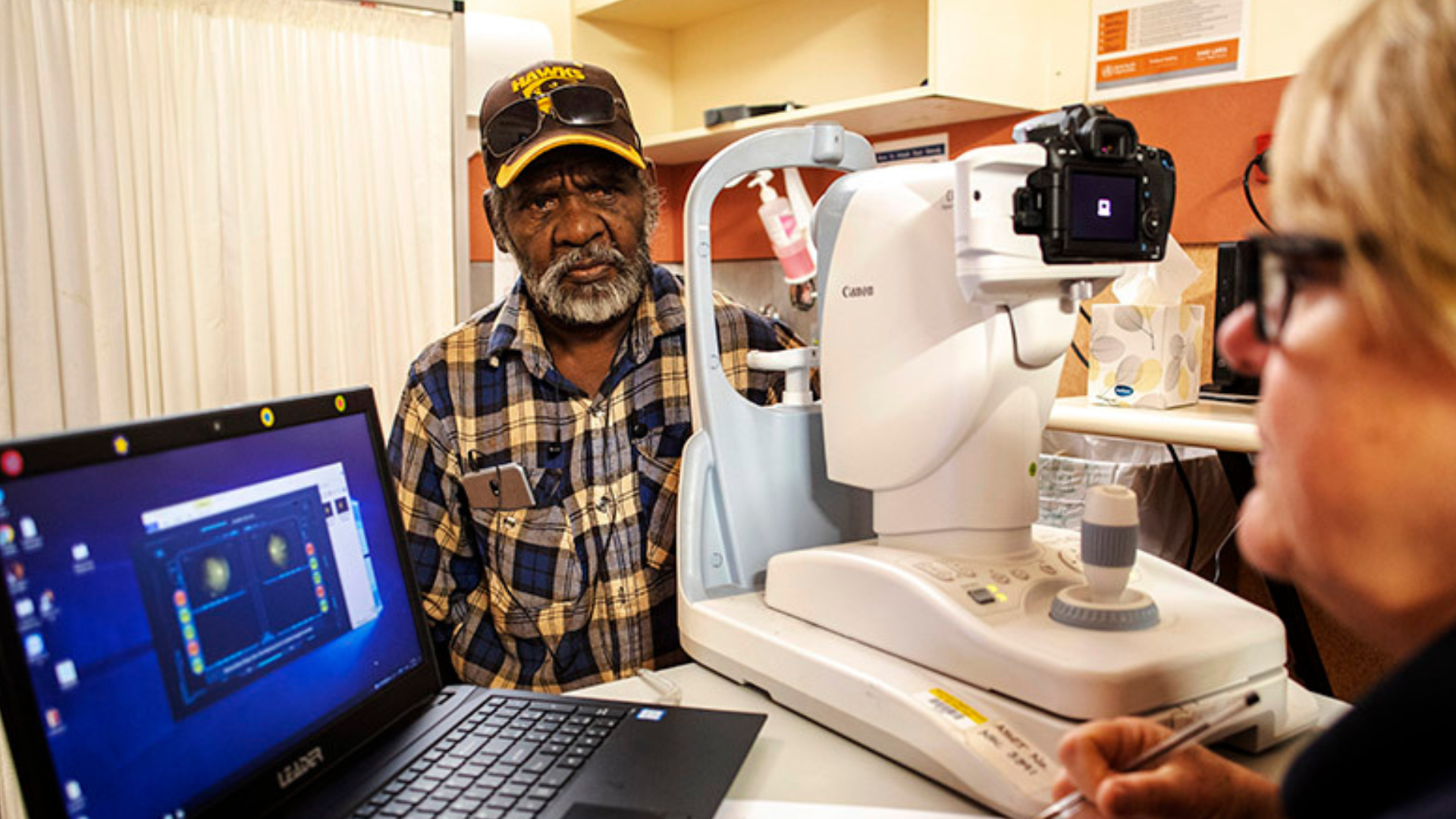
Photo credit: Michael Amendolia
Without access to culturally safe health care, Aboriginal and Torres Strait Islander Peoples face a greater risk of developing preventable and treatable eye conditions, including cataract, refractive error and diabetic retinopathy. Left untreated, these conditions can cause permanent blindness.
The Foundation supports the right to sight, good health care and self-determination through a number of programs and initiatives:
- Indigenous Australia Program: designed to deliver accessible, culturally safe eye care in the communities that need it.
- Uluru Statement from the Heart: we support the Statement and echo the calls of Aboriginal and Torres Strait Islander leaders and communities.
- Close the Gap: we are an active member and supporter of the campaign.
- Aboriginal Community Control: we are actively working towards Aboriginal Community Control and self-determination, as set out in our Reconciliation Action Plan.
This commitment extends to our international work, where the same principle holds: access to eye health care, and freedom from preventable blindness, is everyone's right.
How can I support social justice?
There are many ways to support social justice through The Foundation. You can add your voice to campaigns like the Uluru Statement and Close the Gap, share accurate information about the eye health gap facing Aboriginal and Torres Strait Islander Peoples, or support The Foundation directly.
- Donate to help fund eye health programs and advocacy. For every $1 you give, 75% goes directly towards eye health programs.
- Give monthly as a Visionary. Regular support provides predictable, ongoing funding for community-led programs.
- Start your own fundraising event to raise awareness and funds within your own network.
Frequently asked questions about social justice
What is the difference between equality and equity?
Equality means giving everyone the same resources. Equity means giving people what they need to reach the same outcome. Social justice relies on equity, because treating everyone identically does not account for different circumstances and barriers.
Why is social justice important for eye health specifically?
Eye conditions such as cataract and diabetic retinopathy, and the blindness they cause, are largely preventable or treatable. But treatment depends on being able to access care. Where social justice is lacking, so is access. That is why Aboriginal and Torres Strait Islander Peoples experience higher rates of avoidable blindness than other Australians.
How does The Fred Hollows Foundation support First Nations self-determination?
We support Aboriginal Community Control, back the Uluru Statement from the Heart, and work through our Indigenous Australia Program to ensure communities are empowered to make their own decisions about their eye health and wellbeing.
Is social justice only relevant to Aboriginal and Torres Strait Islander Peoples?
No. Social justice applies to anyone facing discrimination or unequal access based on ethnicity, gender, geography, religion, socio-economic background or disability.
How can I get involved without giving money?
You can share campaigns and information about the Uluru Statement and Close the Gap, subscribe to updates from The Foundation, volunteer your time, or fundraise within your own community.
Explore the many ways to support The Fred Hollows Foundation and our commitment to social justice.
Content updated: 29 July 2026
Meet the author

Jennifer Merryweather
Jen Merryweather is The Fred Hollows Foundation’s Senior Policy Advisor in the Social Justice team. Jen joined the Foundation in 2018 as part of the Indigenous Australia Program, where she worked with the sector to develop Strong Eyes Strong Communities, a five-year plan for Aboriginal and Torres Strait Islander eye health and vision. As part of the Social Justice team, Jen works to build support for the Uluru Statement from the Heart, and to ensure that The Foundation’s commitment to reconciliation is progressed. Before joining The Foundation, Jen worked in policy advisor roles for a range of government and non-government organisations.