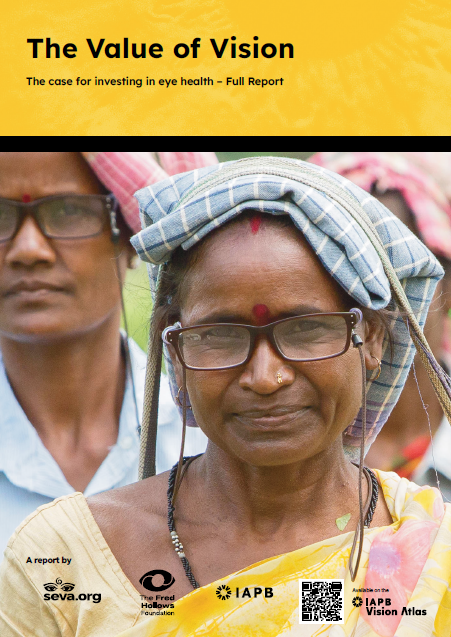
The Value of Vision: The case for investing in eye health

Research from the International Agency for the Prevention of Blindness (IAPB), SEVA Foundation and The Fred Hollows Foundation shows the enormous economic and social opportunity that comes from investing in eye health.
Around 1.1 billion people worldwide live with avoidable vision loss, with 90% of them living in low- and middle-income countries. Without greater investment and action, this number is expected to reach 1.7 billion by 2050.
The Value of Vision: The case for investing in eye health explores what could be achieved by improving access to eye health services and the benefits this could bring to people, communities and economies.
The opportunity to invest in eye health
Vision loss affects much more than a person's ability to see.
For children, poor vision can make it harder to learn and stay engaged at school. For adults, it can affect the ability to work and earn an income. For families, it can increase the time and resources needed to care for someone living with vision loss.
But improving access to eye care can help reverse these impacts.
The research shows that eliminating vision impairment could generate at least $447 billion in economic gains every year.
These gains would come alongside benefits across education, employment, health, safety and family life.
What better vision could bring back
The research estimates that eliminating vision impairment could generate annual benefits including:
- $447 billion in economic gains
- 22 million more people gaining employment
- 304 million people relieved of caregiving responsibilities
- 13 million equivalent school years gained
- 79,800 deaths averted from traffic crashes or among older adults
- 1.2 million non-fatal traffic injuries prevented
- Around 320,000 additional years of life
- 12.2 million cases of depression averted
Together, these figures show how investment in eye health can create benefits that extend well beyond healthcare.
When people can see well, they can be better able to learn, work, care for their families and take part in community life. Children can have more opportunity to stay engaged in education, while adults can remain economically active or return to work.
Families and communities can also benefit when fewer people need to provide ongoing care for someone living with vision loss.
The greatest opportunity is where the need is greatest
The opportunity is particularly significant in low- and middle-income countries, where 90% of people living with avoidable vision loss are found.
In many communities, people face barriers to accessing the eye examinations, glasses, treatment or surgery they need.
Investing in eye health can help address these gaps while strengthening the health systems and workforce needed to provide care into the future.
The research found that a $7.1 billion investment in six priority areas across low- and middle-income countries could generate $199 billion in productivity gains over five years, from 2026 to 2030.
This demonstrates the potential for eye health investment to deliver meaningful returns within a relatively short period, while contributing to longer-term improvements in health and development.
A chance to change the trajectory of vision loss
The number of people living with avoidable vision loss is expected to continue growing without action.
But this is not an inevitable outcome.
Greater investment in eye health can help people access the care they need, while bringing wider benefits to families, communities and economies.
The Value of Vision research provides evidence for governments, funders, organisations and other decision-makers to recognise eye health as an important part of broader health and development investment.
For The Fred Hollows Foundation, the findings reinforce the importance of working with partners to expand access to quality eye care and strengthen sustainable eye health systems.
Read the report
Read the full Value of Vision: The case for investing in eye health report to explore the research, evidence and economic case for investing in eye health.
Download the Value of Vision report.
The Value of Vision: The case for investing in eye health was developed by the International Agency for the Prevention of Blindness (IAPB), SEVA Foundation and The Fred Hollows Foundation, with contributions from a technical working group bringing together expertise, data and lived experience from across regions.
Reference: Wong B, Hennessy J, Stern J, et al., The Value of Vision: The case for investing in eye health, SEVA Foundation, The Fred Hollows Foundation and IAPB, 2025.
Related articles

The $447 billion problem: How vision loss is crippling the global economy


Return on vision: Why eye health delivers one of the highest ROIs in global development

Investing in eye health a $447b opportunity to end avoidable blindness