

About Bangladesh
Bangladesh is one of the world’s most densely populated countries and has made significant progress in health, education and economic development over recent decades. Home to more than 170 million people, the country has reduced poverty, expanded access to healthcare and improved life expectancy.
Despite this progress, millions of people still struggle to access essential eye care services.
Around 14.3 million people in Bangladesh are living with some form of vision impairment, with cataract remaining the leading cause of blindness. The Nationwide Blindness Survey conducted in 2020 found that one in 10 adults aged 40 years or older have low vision or blindness.
Access to eye care remains deeply unequal, particularly for people living in rural and marginalised communities. Limited government services at primary and secondary levels, high out-of-pocket costs and long distances to facilities continue to prevent many people from getting the treatment they need.
Women also face greater barriers to accessing care due to poverty, low awareness and gender inequality.
The Fred Hollows Foundation has been working in Bangladesh since 2008 to strengthen the eye health system, expand community-based services and increase access to affordable, high-quality care for everyone, regardless of where they live.
The eye health challenge in Bangladesh
Many people in Bangladesh are living with avoidable vision impairment because they cannot access timely, affordable eye care.

A growing need
Around 14.3 million people in Bangladesh are living with vision impairment, with cataract the leading cause of blindness.

Unequal access
There are significant gaps in access to eye care services between urban and rural communities, leaving many people without treatment.

Women and girls face greater barriers
Globally, women and girls account for around 55% of people living with blindness and vision impairment, and women in Bangladesh are less likely to access specialist eye care services than men.

High out-of-pocket costs
The cost of treatment, transport and lost income prevents many families from accessing sight-saving care before vision loss becomes severe.
Our work in Bangladesh
The Fred Hollows Foundation has worked with partners in Bangladesh since 2008, strengthening local eye health systems and expanding access to care for underserved communities.
Our work focuses on four key levers for long-term, sustainable change:
Strengthening community eye health services
Expanding outreach programs, vision centres and referral pathways so more people can access care closer to home.
Building the eye health workforce
Training surgeons, clinic staff and community health workers to improve the quality, reach and sustainability of services.
Driving innovation and systems change
Supporting digital innovation, integrating eye health into broader health systems and strengthening referral networks for conditions including diabetic retinopathy.
Reaching marginalised communities
Improving access to affordable eye care for women, rural communities and people who would otherwise miss out on treatment.
Creating a more inclusive eye health system
The Foundation works closely with local partners to strengthen comprehensive, inclusive and affordable eye health services across Bangladesh.
A key focus of our work is ensuring women and marginalised communities can access care earlier and closer to home.
Our gender equity approach includes:
- Designing programs based on evidence and data.
- Building the capacity of staff and partners through gender equity training.
- Increasing awareness of eye health within communities.
- Reducing barriers that prevent women from accessing treatment.
- Strengthening referral pathways between communities and specialist services.
By embedding equity into every stage of program delivery, we can help ensure more people receive the care they need before vision loss becomes permanent.
Our achievements
Since 2008, with the support of our partners, we have:
- Supported more than 3.9 million eye screenings.
- Performed more than 272,400 cataract surgeries.
- Helped reduce the cataract prevalence rate from 1.53% in 2003 to 1.03% in 2020.
- Screened 491,630 people in 2025 alone.
- Performed 48,170 eye operations and treatments in 2025, including 46,900 cataract operations.
- Distributed 29,326 pairs of glasses in 2025.
- Trained 1,005 people in 2025, including community health workers, clinic staff and surgeons.
- Built, renovated or equipped four medical facilities and training centres in 2025.
It’s really unexplainable — the emotion and the feeling. For the last two years I couldn’t see anything, but suddenly I’m seeing everything.

The value of investing in eye health
Eye health is one of the smartest health investments Bangladesh can make.
The Value of Vision report by the International Agency for the Prevention of Blindness (IAPB), The Fred Hollows Foundation and Seva Foundation found that investing USD $129 million in cost-effective eye health initiatives in Bangladesh could unlock USD $2.31 billion in economic benefits over five years.
These benefits include:
- USD $1.46 billion from improved productivity.
- USD $440 million in employee benefits.
- More than 45,000 additional years of schooling.
- USD $313 million in caregiving savings.
Improving eye health does not just restore sight. It helps people return to work, stay in school, care for their families and participate fully in their communities.
Read the full report here.
Scaling up: the next phase
The Foundation’s vision for Bangladesh is a health system capable of sustaining comprehensive, inclusive and affordable eye health services for all.
With increased investment, we can:
- Expand community awareness and early detection.
- Integrate eye health into primary healthcare nationally.
- Strengthen local specialist services and referral pathways.
- Scale vision centres and digital innovation.
- Reduce the cataract backlog.
- Improve prevention, referral and treatment for diabetic retinopathy.
By strengthening systems and scaling proven models, we can help ensure millions more people can access sight-saving care close to home.

Helping mothers like Parveen
After an accident involving a live electrical wire, 23-year-old Parveen began losing her sight to cataract.
By the time her youngest son was born, she could no longer see his face.
“I have eyes but I can’t see,” she said. “My child is in front of me and I can’t properly take care of him.”
Unable to afford treatment, Parveen was referred to Mazharul Haque BNSB Hospital in Chandpur, where she received free cataract surgery supported by The Fred Hollows Foundation and the Australian NGO Cooperation Program (ANCP).
The next morning, when her eye patch was removed, Parveen saw her baby son for the very first time.
With her sight restored, she can once again care for her children and look toward the future with hope.
In 2025, The Foundation and its partners made great progress in key strategic areas in South Asia and the Middle East:
1,892,896
People screened.
163,759
Eye operations and treatments performed including cataract operations, surgeries to treat trachoma, diabetic retinopathy treatments and other sight saving or improving interventions.
70,369
Pairs of glasses distributed.
11,629
People trained including community health workers, surgeons, clinic support staff and teachers.
188,817
School children and community members educated in eye health and sanitation.
195
Facilities built, equipped or renovated.
The countries in South Asia and the Middle East that The Foundation works in are Pakistan, Bangladesh, Myanmar, Nepal, the Occupied Palestinian Territories, Jordan and Afghanistan.
Read more about our work in Bangladesh

The cataract backlog in Bangladesh: What's preventing people from getting surgery?
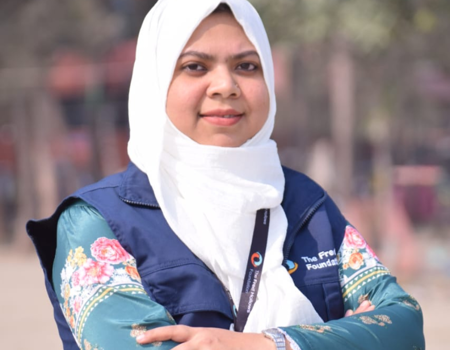

Eye care and life in Cox's Bazar

Restoring sight where life floats on rivers
